
Data Residency in Jira Test Management: What QA Teams Need to Know
What data residency means for test data in Jira, how to check it in a test management app, and how Appsvio Test Management keeps test data in your region.


Companies that operate across borders face growing pressure to meet local data protection and privacy regulations. One critical aspect of this compliance is data residency - the requirement to store and manage data within a specific geographic location. It protects sensitive information, supports legal compliance, and builds customer trust.
From the European Union’s GDPR to Australia’s Privacy Principles and India’s Digital Personal Data Protection Act (DPDPA), nations are enacting laws that enforce rules on where data must be stored and how it can be transferred across borders. For organizations that handle personal or sensitive data, a clear data residency policy is both a regulatory requirement and a competitive advantage.
What is Data Residency and Why is it Important?
Data residency refers to the physical or geographic location where data is stored, processed, and managed. It matters because it helps organizations comply with local laws, protect data privacy, and keep control over their operations.
Storing data within specific borders helps companies avoid legal penalties, minimize risks of data breaches, and meet customer expectations for data protection. Many countries have enacted, or are considering, laws requiring that certain types of data, especially personal or sensitive information - remain within their territory.
Data residency is often confused with two related terms:
| Term | What it means |
|---|---|
| Data residency | Where data is physically stored and processed |
| Data localization | A legal requirement that certain data stays within a country’s borders |
| Data sovereignty | The principle that data is subject to the laws of the country where it’s stored |
The Impact of Data Regulations Globally
Several major jurisdictions have strict data laws:
- European Union’s GDPR enforces data portability and restricts cross-border data transfers.
- United Kingdom implements its own version of GDPR post-Brexit, known as UK GDPR.
- Australia’s Privacy Principles (APPs) oversee data collection and storage practices.
- India’s Digital Personal Data Protection Act (DPDPA) mandates data localization for personal data processing within the country.
- California Consumer Privacy Act (CCPA) and Consumer Data Protection Act (CDPA) in other regions also influence data management strategies.
The details differ from law to law, but the direction is the same: keeping data where it originates makes compliance easier and reduces risk.
In Search of Data Residency Solutions
As these laws tighten, companies need tools that store data locally without slowing their teams down. The challenge lies in managing data across regions with varying regulations. For example, the DPDPA in India not only emphasizes data localization but also calls for strict controls over how personal data is transferred outside the country. Non-compliance can lead to not only heavy penalties, but damage to reputation and loss of customer trust as well.
Organizations need tools that support local data storage, facilitate compliance and maintain seamless operational workflows. This is especially critical for QA and development teams, who handle sensitive test data that must be stored and processed according to local laws.
What Test Data Falls Under Data Residency?
Test management tools hold more sensitive data than many teams expect:
- Test cases and steps can describe business rules and internal processes.
- Test data and preconditions sometimes include personal data, such as real customer names or email addresses copied from production.
- Execution results and evidence, like screenshots and attachments, can show customer records on screen.
- Defects often include examples of the data that caused the problem.
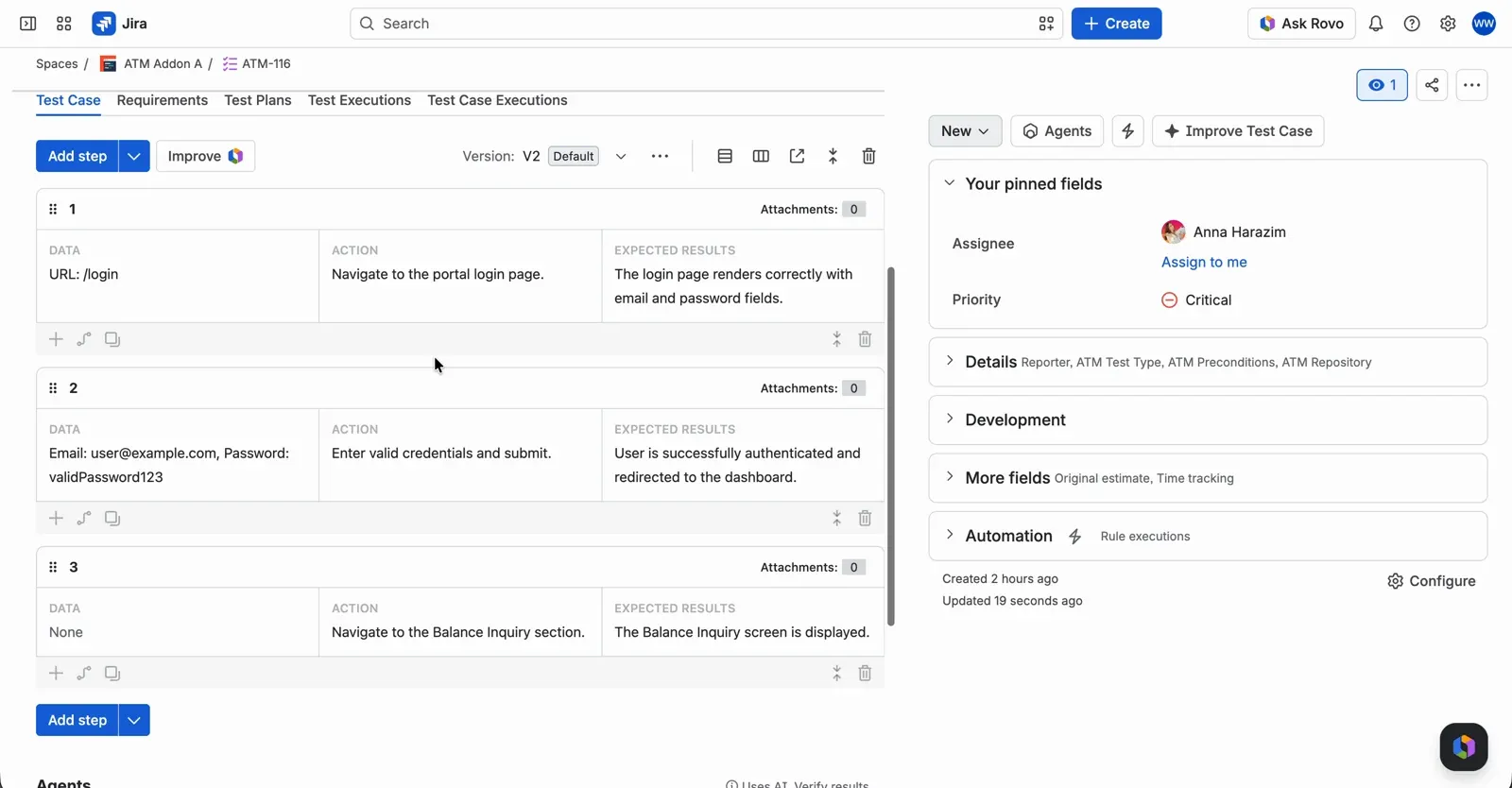
An ATM test case in Jira with three saved steps, each with Data, Action and Expected Results columns.
Data residency usually covers data at rest, so check how each tool handles the data types above.
How to Check Data Residency in a Jira Test Management App
Before you choose a test management app, check that:
- the Marketplace listing’s Privacy & security tab lists the regions you need,
- the app’s data moves with your Jira site if you change its data residency location,
- no test data is sent to servers outside Atlassian (data egress),
- the app is built on Forge and shows the Runs on Atlassian badge, which confirms it runs entirely on Atlassian’s infrastructure.
What about Appsvio Test Management?
Appsvio Test Management (ATM) adds robust test management features to Jira. Built exclusively on Atlassian Forge, ATM allows organizations to store and manage test data within any Atlassian-supported region, including India.
Currently, ATM is the only solution on the Atlassian Marketplace that supports data residency in the Indian region explicitly, aligning perfectly with India’s DPDPA requirements. Whether it’s test planning, executing, or reporting, ATM ensures that all test-related data remains securely stored within the jurisdiction, complying with data localization laws.
How ATM Supports Data Residency
Thanks to its architecture built on Forge, ATM offers flexible data storage options that adhere to local laws and regulations. This means companies can confidently perform their testing activities, knowing that their sensitive information stays within the desired geographic boundary.
India is only one example: many countries have similar rules that require data to stay within national borders. ATM runs entirely on Atlassian’s infrastructure, holds the Runs on Atlassian badge, and doesn’t send data outside Atlassian, which helps reduce legal risk and simplifies security reviews.

The Appsvio Test Management for Jira listing on the Atlassian Marketplace, with Atlassian Enterprise Certified and Runs on Atlassian under trust signals.
Data Residency: a Modern Necessity
For organizations in countries with strict data protection laws, such as India, Australia, or those covered by GDPR, data residency is a requirement, not an option. It’s a core part of compliance, security, and trust.
For QA managers and testers, a tool like Appsvio Test Management takes one item off the compliance checklist: test data stays in the same location as your Jira site, and the team keeps working in Jira as usual.
Store Jira test data in your region without vendor access
Choose where your Jira test data is stored and meet regional compliance needs.
Get free trialFAQs
Related posts

Dariusz Jaroń
•Oct 2, 2026


Dariusz Jaroń
•Sep 23, 2026