In Remote Work, Feedback Is No Longer Just Feedback
Why perks alone can't build workplace wellbeing. How a Kudos-based feedback program called Made My Day restores connection in remote IT teams.

In this blog post, I’d like to share my experience of how feedback and positive recognition help people feel seen, motivated, and connected in remote teams.
However, this article is also the beginning of something bigger.
INFO
About Made My Day
Over the coming weeks, I’ll be sharing a series of conversations with people from our business ecosystem. Together, we’ll explore topics that are at the heart of building strong organizations: creating meaningful feedback processes, defining and bringing company values to life, building organizational culture, and everything that helps people feel connected, motivated, and part of something bigger.
I’m really excited about the different perspectives and experiences these conversations will bring. More conversations and stories are coming soon. Stay tuned.
Now, let’s move on to the article.
The Golden Era of the IT Industry Is Over
The IT industry is undergoing a massive transformation. You could even say that a certain “golden era” has come to an end.
After years in which technology companies offered employees a very wide range of benefits - from the famous “fruit Thursdays” and gym memberships to almost unlimited budgets for integrations, training, and bonuses - we are now seeing a clear shift in how organizations think about employee wellbeing.
Economic challenges, more cautious investment decisions, and shrinking budgets have made companies look at costs much more carefully. But this doesn’t mean that development, wellbeing, and a sense of security should take a back seat. Quite the opposite.
Today, the question is no longer: what perks can we offer to attract talent?
The real question is: how can we create an environment where people don’t just work, but truly belong?
Because today’s employees, more than ever before, need certainty, community, and the feeling that they are part of something bigger than a list of tasks in Jira.
Loneliness in the IT World
The paradox of modern technology work is glaring: we have never had so many communication tools, yet never before have so many people felt so isolated.
Remote and asynchronous work have given us immense freedom. They’ve allowed us to manage our time better, reduce commuting, work from different places, and often combine professional and private life more effectively. But this freedom has also come at a hidden cost.
We have fewer spontaneous conversations. Fewer accidental coffee chats. Fewer quick glances, smiles, gestures, and micro-reactions that used to help us understand what was really happening on the other side of the screen. We no longer receive the full spectrum of non-verbal signals we instinctively rely on as humans.
Human communication isn’t built on words alone. We communicate through tone of voice, facial expressions, pauses, energy, and presence. In remote work, many of these signals fade. What remains are written messages, tickets, statuses, short calls, and, increasingly, conversations with AI tools.
Instead of asking a teammate how they would solve a problem, we ask a chatbot. Instead of asking someone for a second perspective, we write a prompt. Instead of building a relationship by solving something together, we increasingly solve everything on our own - faster, more efficiently.
Often, it works brilliantly. But behind the convenience of automation and remote setups hides a dangerous reality: gradual isolation.
A Benefit Cannot Replace a Bond
For years, organizations tried to buy employee loyalty and comfort with perks. But a benefit cannot replace a relationship.
A gym membership cannot replace a conversation with a leader. A training budget cannot replace the feeling that someone recognizes your effort. Fruit Thursdays cannot replace community. And an extra bonus doesn’t always answer the fundamental question: “Do I really matter in this organization?”
That’s why wellbeing cannot be reduced to a catalogue of perks. True wellbeing begins where people feel noticed, needed, and connected.
I believe that one of the most important things organizations can do today is create an environment where people can grow consciously and intentionally, without being left alone with that growth. To make this happen, companies need transparent promotion systems, clear development criteria, and regular, honest communication about career paths.
And that last element is absolutely crucial, because even the best development system fails if employees don’t receive feedback, don’t understand their impact, and feel like they’re walking their path alone.
Nobody develops in silence. And nobody thrives in loneliness.
Seligman and the Need for Belonging
This is where Martin Seligman’s theory of wellbeing, especially his PERMA model, fits perfectly. Seligman demonstrates that human happiness isn’t based on temporary comfort. It consists of several elements, including positive emotions, engagement, relationships, meaning, and accomplishment.
And this is exactly why traditional benefits aren’t enough.
A benefit can improve comfort. It can be a nice addition. It can create a momentary positive feeling. But by itself, it rarely builds deep relationships, a sense of meaning, awareness of impact, or a lasting sense of accomplishment.
A well-designed feedback culture, however, hits every element of the PERMA model. Positive feedback sparks positive emotions, while genuine appreciation strengthens relationships. Understanding your impact creates meaning, and recognizing specific milestones reinforces accomplishment.
In the world of remote and asynchronous work, feedback is no longer just an HR tool - it’s a tool for restoring human connection. It’s a bridge between the individual and the team, sending a clear message: “I see you. Your work matters. You belong here.”
Feedback Is More Important Today Than Ever Before
In our company, the answer to these needs became a feedback process based on four different pillars. One of its elements is the Made My Day program, which we created using Jira Service Management and Slack. In our internal materials, this program is described as part of a broader four-stage feedback system designed to bring the human element back to the forefront in the world of IT.
See Feature Bundle in action
Discover how easy it is to design clear ticket journeys, customize your JSM portal, and launch instant self-service.
Go to Atlassian MarketplaceMade My Day was born from a very specific need: we wanted our company values to be more than just dead text on a Confluence page. We quickly realized that even the best-defined values “die” if they aren’t regularly reinforced and connected to real employee behaviors.
That’s why we created a Kudos system. Every employee can give Kudos to anyone else in the organization. It’s not a mandatory corporate exercise or an engine for empty praise - it’s a conscious act of gratitude. An employee simply selects a company value, chooses a colleague, and writes a few meaningful words explaining why they appreciate them.
To make giving Kudos as simple as possible, we integrated Feature Bundle alongside Jira Service Management and Slack. This combination removed friction from the process, making it incredibly easy for employees to submit recognition, track the status of their Kudos, and see the appreciation workflow in action.
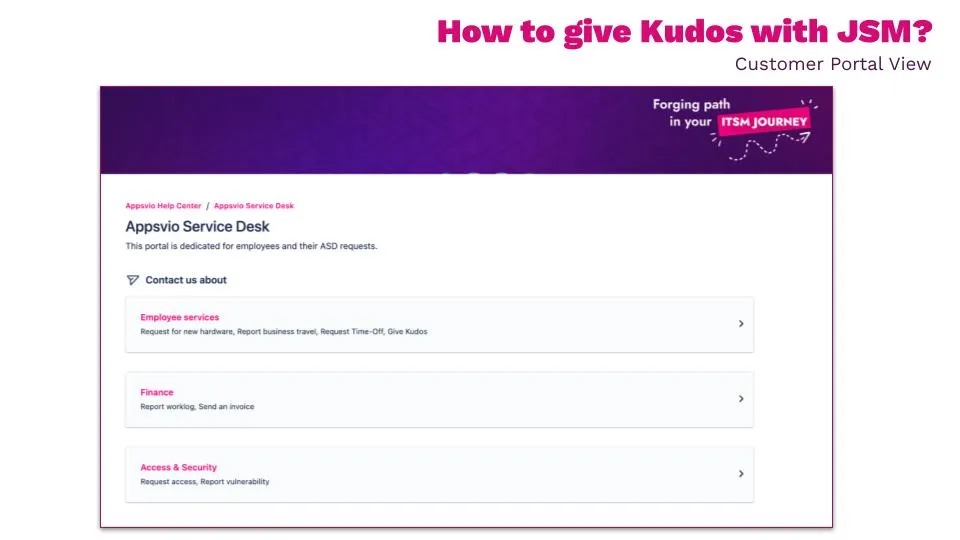
How to give Kudos with JSM?
The entire process runs through Jira and automatically publishes to a public Slack channel. Technology didn’t create our culture of appreciation, but it successfully removed the friction that often prevents people from expressing gratitude. As a result, recognition becomes visible, transparent, and accessible to everyone.
Public Appreciation as an Act of Building Community
The tools themselves, Jira and Slack, are just infrastructure. What matters is that positive feedback stops being a private, accidental gesture and becomes part of the organization’s shared space.
When someone publicly appreciates another person, several things happen at the same time:
- The appreciated person receives a clear message: “Your action mattered.”
- The team sees which behaviors are important.
- Company values become connected to concrete actions.
- The organization builds a shared language of recognition.
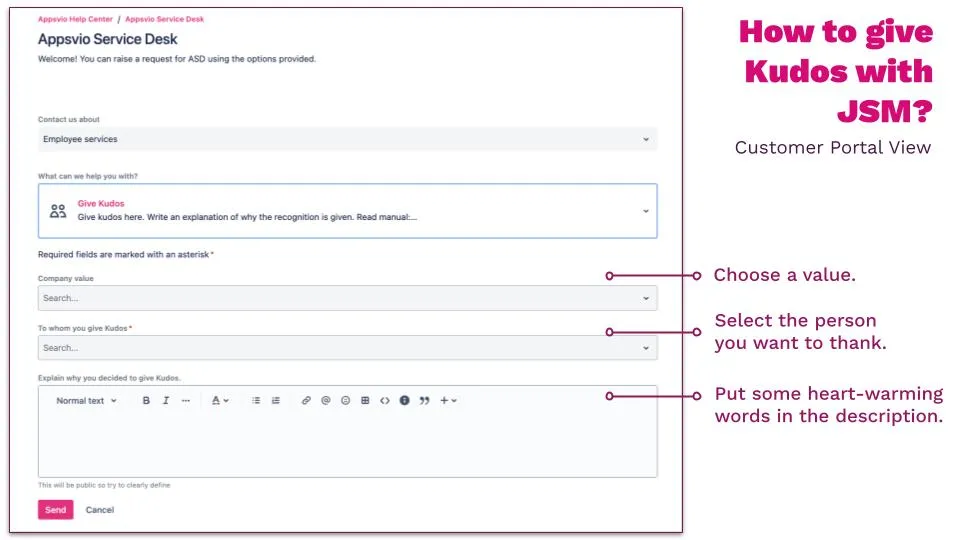
Giving Kudos with JSM step by step
This is vital in remote work, where many good things happen quietly. Someone helps someone else. Someone takes responsibility. Someone reduces tension. Someone supports a new person. Someone does more than their role requires.
In the office, these things were often visible naturally.
In remote work, they can easily disappear.
That’s why systematic positive feedback helps bring to light the behaviors that might otherwise remain unnoticed.
At work, we often focus mainly on tasks and negative feedback. We tend to believe that only pointing out what needs to be improved produces measurable results. We forget that public, positive feedback can often be a stronger motivator for development. Made My Day shows the entire team, in a simple and visible way, that people’s effort is noticed and appreciated.
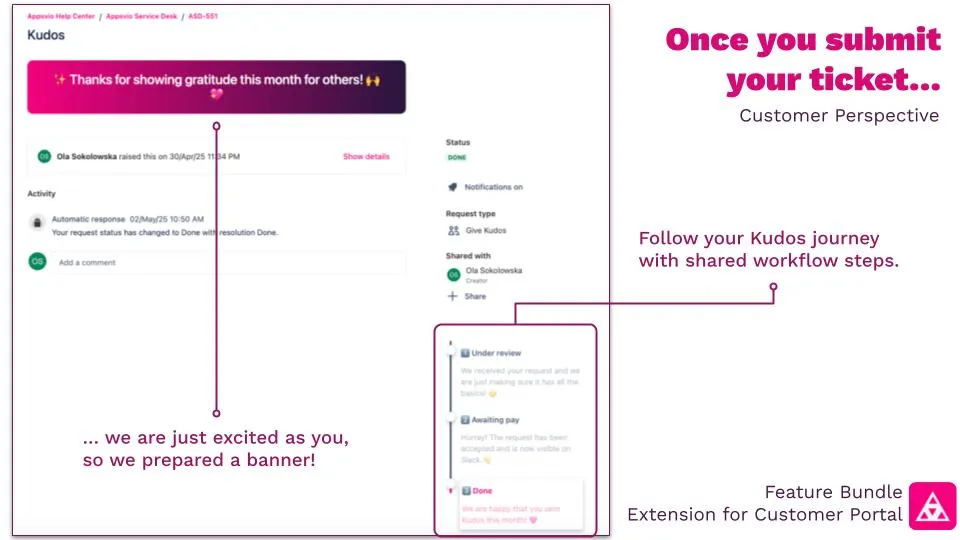
Giving Kudos - customer view
From Feedback to Natural Leadership
Over time, we saw that Made My Day had become something much bigger than just an appreciation tool. It also became a valuable network for identifying natural leadership.
We began to notice which people were naturally appreciated by others. Who truly supported the team. Who built collaboration. Who took responsibility. Who had a positive impact on the organization, even if this hadn’t previously been visible in traditional structures, KPIs, or formal processes.
This is extremely important because, in the world of remote work, influence often becomes less visible. We don’t always see who supports whom. We don’t always know who helps resolve conflicts. We don’t always notice the people who quietly stabilize the team. We don’t always recognize those who build psychological safety around them.
Made My Day helps us see these things.
As a result, decisions related to development paths, promotions, and identifying future leaders can become more conscious. They’re not based only on who is the most visible in meetings, but also on who genuinely builds community.
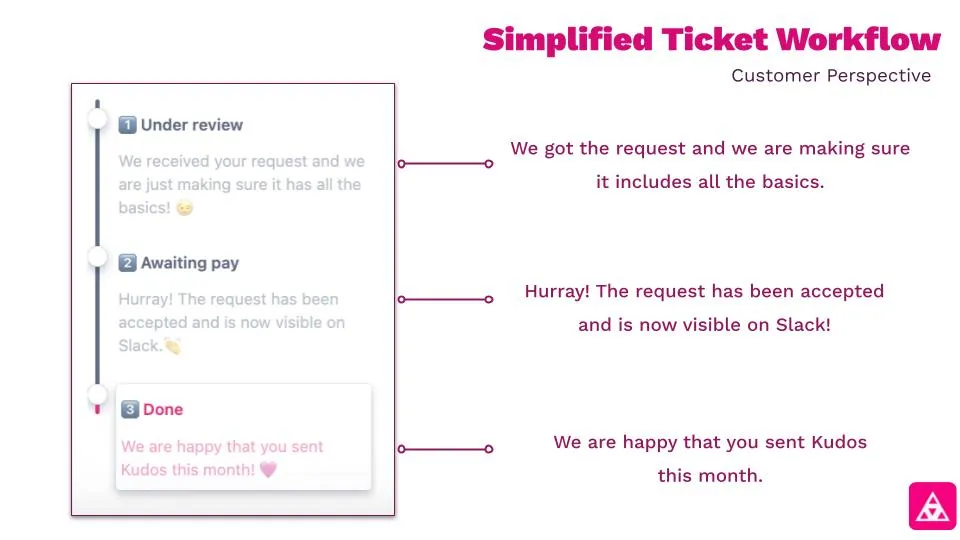
Simplified ticket workflow
Remote Work Needs Rituals of Closeness
At the same time, I strongly believe that no feedback system should ever become an excuse to give up face-to-face contact. Quite the opposite: the more we work remotely and asynchronously, the more intentionally we must design opportunities for real, human meetings.
Companies should treat face-to-face contact not as a luxury, a cost, or a nice addition, but as an important element of building a healthy organization.
Face-to-face contact restores what Slack, Jira, and Zoom calls lose. It allows us to see the whole person, read the room, catch the tone, and feel the team’s energy. It builds trust faster than a thousand chat messages. It reminds us that behind every avatar and ticket, there is a real human being.
Remote work is a massive net positive. But to keep it healthy, it requires consciously designed rituals of closeness: regular feedback, physical meetings, and unstructured space for conversation.
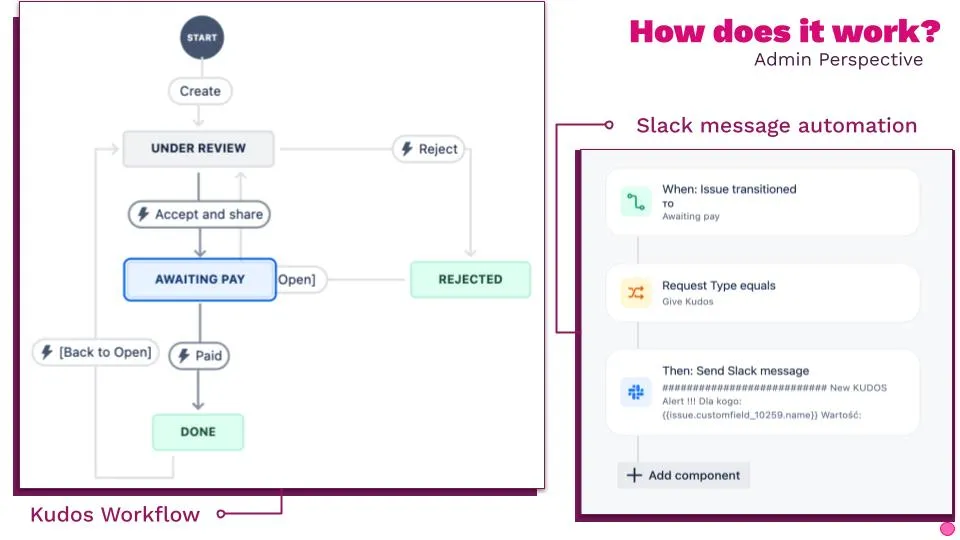
Giving Kudos - admin perspective
A New Dimension of Wellbeing
Today, wellbeing in IT should mean something more than benefits.
It should mean designing an environment where people feel a sense of belonging, see meaning in their work, know how they can grow, and feel that their presence matters.
This matters immensely now, when AI is increasingly taking over some of our everyday cognitive interactions. Instead of asking a colleague, we ask a model. Instead of exploring a problem together, we ask a tool for a solution. Instead of building relationships through collaboration, we optimize the process.
Don’t get me wrong - efficiency isn’t bad, but it requires organizations to be far more intentional. If technology takes over our functional interactions, companies must take radical care of our human interactions, not through accidental or symbolic gestures once a year, but through structured, cultural habits.
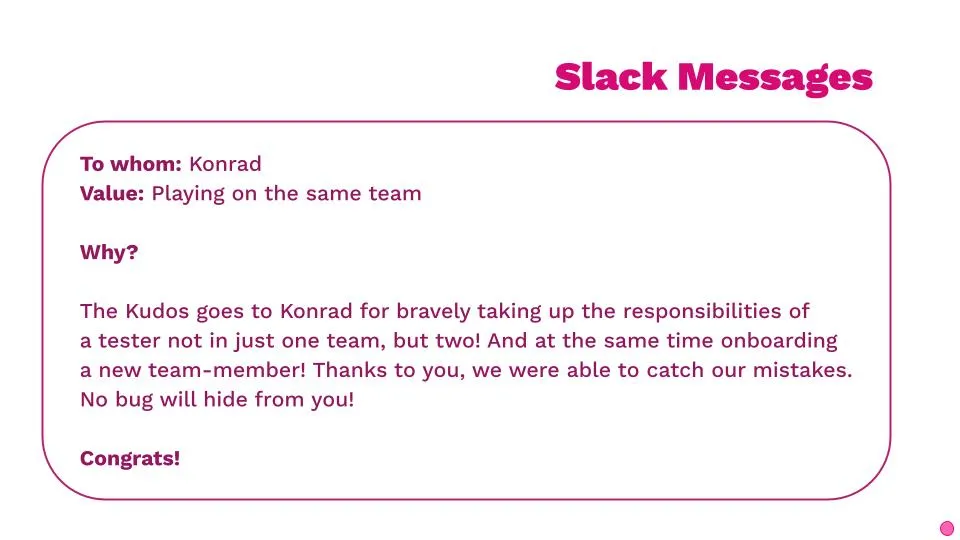
A sample Kudos view on Slack
Employees Need Certainty That They Are Not Alone
The greatest value of a healthy feedback culture is certainty.
Certainty that you are seen. That your work matters. That company values aren’t empty PR. That your career growth isn’t random. And that, despite the physical distance of remote work, you remain part of a collective.
In a world where it’s becoming easier and easier to work alone, write alone, analyze alone, and solve problems alone, this certainty becomes priceless.
An employee can work remotely, use AI, work asynchronously, and have a flexible schedule with excellent tools - but they still need people. They need relationships, recognition, meaning, and community.
And perhaps today, more than ever before, the most important task of an organization is not to invent more benefits.
The most important task is to remind people that they are not alone.
Related posts
Katarzyna Pawlak
•Sep 24, 2026
Dariusz Jaroń
•Jul 29, 2026
Katarzyna Pawlak
•Jul 3, 2026