Ditch Expensive P2P Recognition Tools: How to Build the "Made My Day" Kudos System in JSM
Build an automated employee recognition program inside JSM. Discover how to connect Assets, Feature Bundle, and Atlassian Rovo for deep cultural insights.

Many growing companies face the same challenge: they want to build a strong culture of gratitude, so they start looking for external employee recognition software like Bonusly or Tap My Back. But adding another SaaS tool means higher costs, another password for your team to remember, and historically low adoption rates.
What if you could build a structured, automated kudos system using the tool your team already opens every single day?
At Appsvio, we decided to challenge ourselves. Instead of buying another software license, we built a complete peer-to-peer recognition program called “Made My Day” entirely inside Jira Service Management (JSM). Here is the exact blueprint of how we configured it, how the data flows, and the concrete business value it delivers.
How to structure Atlassian Assets for bi-directional employee recognition?
Instead of relying on isolated third-party databases or flat text fields, your recognition framework should live inside the native JSM Assets. To achieve this, configure two distinct object schemas:
- Employees Object: Stores critical user attributes including Name, Email, Team, and Manager.
- Company Values Object: Stores your core organizational pillars (e.g., Happy Customer = Happy Employee, Flexibility).
The true superpower of this setup is bi-directional linking. When you open the Assets view for the Company Value “We play towards a common goal”, you immediately see a complete list of all requests where that value was selected. The same applies to the Employee view, providing Human Resources (HR) with a clean, centralized record of all kudos given or received by an individual directly within their profile.
How to configure a mobile-friendly JSM portal for peer recognition?
To provide a friction-free user experience, we set up a dedicated Request Type in our Employee Portal called “Give a kudos”. Since the JSM customer portal is completely mobile-friendly, employees are not tied to their desks - they can submit kudos directly from their smartphones whenever inspiration strikes.
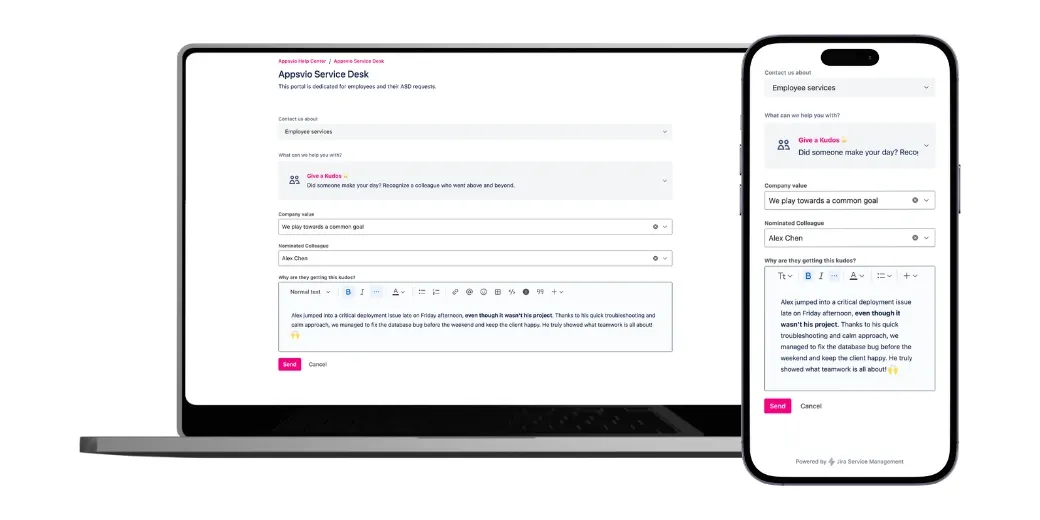
The streamlined, mobile-responsive “Give a kudos” intake form where employees can easily nominate peers and select the corresponding company value on the go.
To make the interface feel like a premium, standalone HR tool rather than a standard IT ticketing system, we supercharged the portal using Feature Bundle for Jira Service Management:
- Success Banner: The moment an employee submits the form, Feature Bundle displays a custom success banner confirming the kudos has been registered and will be announced at the end of the month. These banners can even be restricted by language to match the employee’s preferred localization settings.
- Ticket Journey: A visual path shows the user exactly what happens next, tracking the ticket from HR Review, through Awaiting Pay, to the final Done.
- Customer Actions for Flexible Editing: Inspiration often strikes outside working hours, but typos happen. Feature Bundle fully supports the editing of Asset fields post-creation. This means employees can autonomously edit their entry to fix mistakes or change descriptions through Customer Actions right up until the moment HR accepts and transitions the ticket.
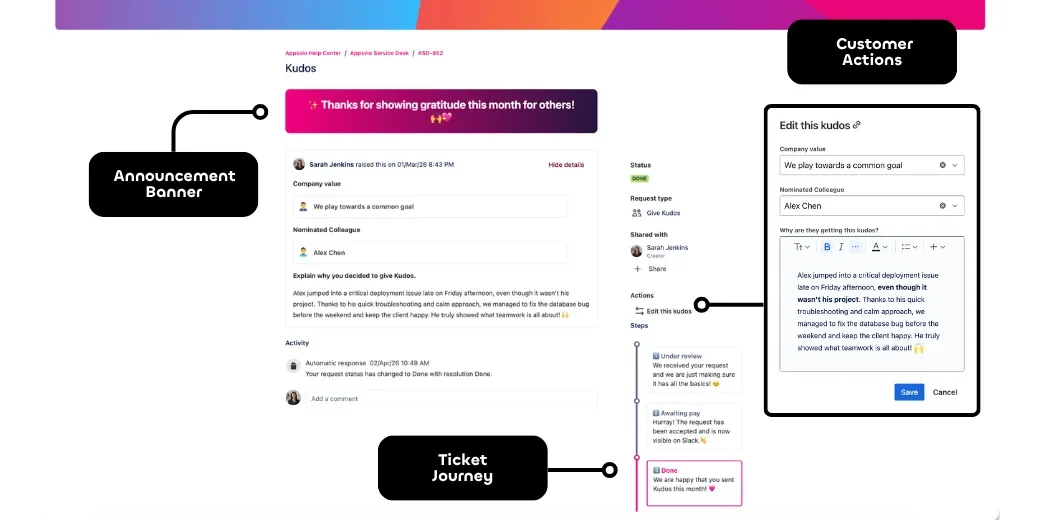
Premium portal user experience delivered by Feature Bundle, highlighting a localized thank-you banner, clear workflow journey path, and self-service edit actions for employees.
See Feature Bundle in action
Discover how easy it is to design clear ticket journeys, customize your JSM portal, and launch instant self-service.
Go to Atlassian MarketplaceHow to automate the kudos lifecycle and Slack announcements?
At Appsvio, we value simplicity, so our core workflow is straightforward and requires no complex management approvals for standard recognition. The workflow dynamically manages the lifecycle of the monthly nominations:
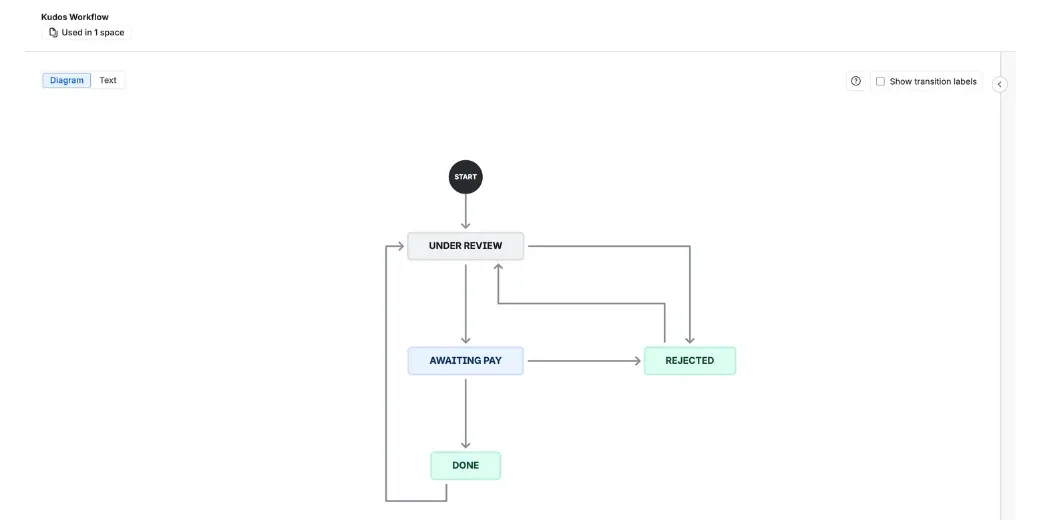
Our frictionless, high-velocity JSM workflow designed to automate fulfillment without adding administrative approval overhead.
- HR Queue Management: HR utilizes a dedicated JSM queue to quickly review incoming entries for appropriate content and monitor which ones are approved and awaiting payout.
- Sender Confidentiality: To keep the focus purely on the positive feedback itself, the reporter’s name is kept hidden from the recipient by default. However, if the author wants to reveal themselves, they simply add their colleague to the Request Participants field.
- The Monthly Publication: On the last day of the month, an automation rule triggers. It searches for all tickets in the Awaiting Pay status and sends a bulk webhook message to our public #appsvio Slack channel, displaying the recipient, the description, and the related company value.
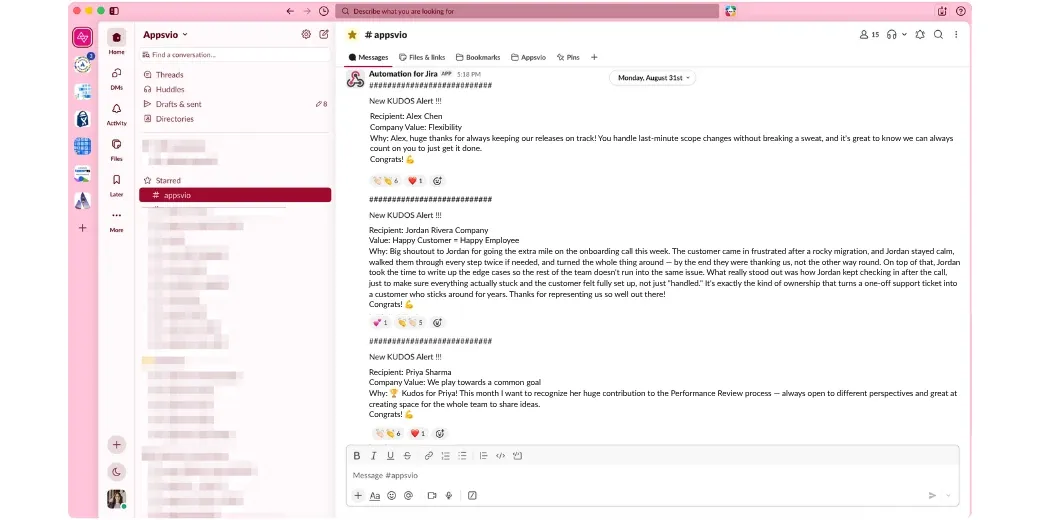
The automated monthly “Made My Day” digest broadcasted automatically to the public company channel via Jira Automation webhooks.
How to drive engagement using proactive Jira Automation reminders?
To ensure employees do not forget to appreciate their colleagues, we set up a proactive reminder rule in Jira Automation. If an employee has not created a kudos ticket by noon on the last day of the month, the system automatically sends them a friendly nudge.
How to configure the rule:
- Trigger: Scheduled (Runs on the last day of the month at 12:00 PM).
- JQL / Assets Search: Identify employees who have not created a ticket in the Kudos project during the current month.
- Action: Send an email to those specific users.
Email Content Template:
Subject: Don’t forget to make someone’s day today! 🌟
Hello {{recipient.Name}},
The month is coming to an end, and our monthly “Made My Day” announcement goes live on Slack in just a few hours.
Did a colleague help you solve a complex problem this month? Did someone support you during a busy week, or simply bring great energy to the team? Now is the perfect time to say thank you.
It only takes a minute, and your feedback can be submitted directly from your phone. Head over to the Customer Portal and submit your kudos before 4:00 PM today. Let’s make sure no good deed goes unnoticed!
Best regards, Your HR Team
How to scale standard kudos into multi-tiered premium rewards?
While our Appsvio workflow is direct, the beauty of building this program inside JSM is its incredible modularity. If you are launching this in a large enterprise, you can easily scale the architecture to introduce multi-tiered tracking:
- Standard Kudos: Day-to-day peer appreciation that follows the basic, frictionless workflow.
- Premium Kudos (Manager Approval): For exceptional, cross-departmental achievements involving higher monetary values. Using Jira Automation, you can automatically pull the recipient’s Manager attribute from their Assets profile and insert a dynamic Approval step into the workflow before the ticket reaches the HR queue.
How to measure corporate culture using native Jira Dashboards?
Because every kudos is a native Jira ticket connected to Assets, data reporting becomes a superpower. We use standard Jira gadgets on a shared dashboard to provide Management and HR with clear metrics answering two vital questions: Which company values are being lived out the most this quarter? and Which teams or individuals are receiving the most kudos?
- Pie Chart Gadget: Configured to map issues by the Company Value custom field. This instantly illustrates which corporate values are dominating the organization’s daily operations.
- Two-Dimensional Filter Statistics Gadget: Configured with the Employee on the X-axis and the Number of Issues on the Y-axis. This matrix reveals team dynamics, showing exactly which departments are collaborating and supporting each other the most. In larger organizations, this can be broken down using any custom attribute inside the Employee schema, for example, Team.
How can Atlassian Rovo (AI) extract qualitative cultural insights?
During annual Performance Reviews, managers use Atlassian Rovo to instantly scan the kudos. Instead of manually reading through dozens of tickets, prompting Rovo provides deep, qualitative insights in seconds:
Example Rovo Prompt: “Analyze the ‘Appsvio Service Desk’ project for Employee [Name] from the last 12 months. Summarize their top 3 strengths based on peer feedback. Also, look at the kudos this employee gave to others - what behaviors do they appreciate the most in their colleagues?”
To take this a step further, you can build a dedicated Kudos Culture Insights Agent.
- Role: Organizational Culture and Engagement Analyst.
- Knowledge Sources: JSM Kudos requests history, Employees/Values Asset schemas, and company goal documentation.
- Behavior: Instruct the agent to run automatically at the end of each quarter to compile a culture trend report for the leadership team. It handles the numerical heavy lifting while using LLM semantic analysis to identify hidden cultural shifts - such as recognizing if a specific engineering squad is experiencing high burnout based on a sudden surge of peer kudos thanking them for handling extra night shifts.
Win-Win: Benefits for Every Stakeholder
Now that you see how the system functions under the hood, it is clear how this single Jira Service Management setup delivers targeted value across the entire corporate matrix:
| Stakeholder | Key Benefits |
|---|---|
| Employees | No new tools to learn. Access to a mobile-friendly portal allows them to say thank you effortlessly from anywhere, increasing everyday morale. |
| HR Teams | Complete control over the approval queue. HR gets deep data on culture, helping them identify helpful employees whose work often goes unnoticed by management. |
| Managers | Instant visibility into team dynamics. Managers receive automated email notifications when someone commends their team member, making 1-on-1 feedback much richer. |
| The Board / C-Level | Zero additional SaaS licensing costs. They get a data-driven overview of how company values are being lived in practice, not just written on a wall. |
TIP
Pro-Tip on External Payouts: If you want to attach monetary rewards, you can easily integrate platforms like Tremendous. Once a kudos is approved, HR generates a reward link and pastes it as an external comment on the JSM issue, triggering a direct email to the employee with their gift card.
Try Made My Day in Your Company
Using native JSM features paired with smart portal customization gives you enterprise-grade HR functionality without the enterprise price tag.
Want to build this exact system? To get the smooth user editing options, mobile-friendly custom ticket journeys, and beautiful success banners we used for “Made My Day”, check out our app.
Start your free trial of Feature Bundle for JSM
Get the smooth user editing options, mobile-friendly custom ticket journeys, and beautiful success banners we used for “Made My Day” on the Atlassian Marketplace today.
Start free trialRelated posts
Dariusz Jaroń
•Aug 12, 2026