
Agile Testing: Principles, Lifecycle & Best Practices for QA Teams
What is agile testing? Learn its key principles, how it differs from traditional testing, the agile testing lifecycle and quadrants, and how to run it in Jira.

Agile testing is a software testing approach that follows the principles of agile development: testing happens continuously in every sprint, alongside development, instead of in a separate phase at the end. Testers, developers, and product owners share responsibility for quality and get feedback within days rather than months.
This guide covers how agile testing differs from traditional testing, its core principles, the agile testing lifecycle and quadrants, and how to run it in Jira.
Traditional vs. Agile Testing Methods
The testing process is tightly integrated with the software development cycle and it is also affected by the delivery method used in the project. While there are multiple routes with which project goals could be achieved, two approaches, traditional and Agile, can be recognized immediately, both of which influence the workflow of the testing process and its placement in the whole development cycle.
Choosing the traditional path allows for a more rigid framework, where testing becomes the very last step, as the previous phases of development need to be completed before moving forward. This way, a clear structure of the project is created, limiting the probability of chaos and the rise of mistakes. On the other hand, if any changes are to be made, it is next to impossible to implement and address them immediately. In this scenario, the overwhelmed QA team is bound to miss deadlines and sacrifices have to be made in the long-run.
Agile methodology flips this narrative completely, as development environments tend to be more dynamic and flexible, a complete opposite to the traditional ways. Here, testing happens at every stage of development and is continuous for every iteration of the development cycle. With the testing process running simultaneously with the development, no time is lost because of waiting for the completion of the previous phase. The teams work hand in hand, constantly moving the production forward and as a result the release cycles are shortened.
But how does the quickness affect the quality of the end-product? Against all odds, the quality can be significantly increased, as the defects are detected much earlier and the chances of carrying over bugs to the product-launch are minimized.
| Traditional (waterfall) testing | Agile testing | |
|---|---|---|
| When testing happens | After development is complete | Continuously, in every sprint |
| Who is responsible | A separate QA team | The whole team, with testers leading |
| Requirements | Fixed upfront in documents | User stories refined each sprint |
| Feedback | Late, often weeks or months after coding | Within the same sprint |
| Handling change | Expensive and slow | Expected and planned for |
| Documentation | Detailed test plans and reports | Lightweight, kept next to the work |
The Core of Agile Testing
Undeniably, the benefits of Agile are present, but the QA teams embarking on this journey should keep in mind the principles of Agile testing. Although these rules are not necessarily fixed in stone, testers can treat them as guidelines amidst the controlled chaos of Agile.
Main goal is customer satisfaction
Positive customer experiences with the product are always in the heart of every project. They should not be forgotten, even in testing. After all, it’s the testing teams who validate whether the software will meet the base requirements of users.
Simplicity and adaptability
The Agile methodology requires testers to be extremely flexible and be able to quickly adjust to the ongoing changes in the project. This dynamic environment also requires teams to constantly prioritize and make sure that their work aligns with the goals. As a result, must-have tests always take priority.
Constant communication and collaboration
In such fast-paced projects, teams cannot afford to have miscommunication issues. Collaboration is at the center of their work - testers need to share feedback and test results with developers, without any interruptions. During team meetings, they update their daily plans, making sure that the end-goal is within their reach and that the stages of the development process flow smoothly together.
Test early and continuously
Testing starts when a user story is refined, not when it’s coded. Testers help write acceptance criteria and review designs, so many defects are prevented before they reach the code.
Quality is a whole-team responsibility
In agile teams, quality isn’t handed off to QA at the end. Developers write unit tests, product owners define acceptance criteria, and testers guide the overall approach and explore what others might miss.
Automate what you repeat
Short sprints leave no time to rerun the same checks by hand. Teams automate regression tests and keep manual effort for exploratory testing and new features, where human judgment matters most.
The Agile Testing Lifecycle
With those values in mind, testing in Agile becomes its own lifecycle of sorts. The created, continuous loop consists of planning, executions and schedule adjustments. In these scenarios, teams don’t only consist of developers and testers, as they can easily engage product owners or stakeholders, etc. So what does this cycle look like?
Defining requirements
The first step to testing is the definition of requirements. At this stage, teams review user stories and gather product input from stakeholders. Once the acceptance criteria are in the clear, they get divided into requirements.
Designing test cases
All parties involved design how the software will be validated against requirements. Together, they prepare a testing schedule, outline the process and set expected results.
Daily adjustments and planning
Teams meet everyday to share updates regarding testing status and adjust their plans if necessary. By allocating the regular and frequent meeting time in their schedules, they ensure a smooth information flow. With priorities set daily, everyone can quickly adapt to any changes and the risk of falling behind is reduced.
Executing tests
Testing is intertwined with the development process - once the feature is complete, there’s no reason to wait, the testing starts immediately. The progress is also constantly monitored by other team-members, such as stakeholders, in order to make sure that the reality matches the theoretical plans.
Reviewing defects
The final stage is the review of discovered defects in terms of severity and impact on the software. Bugs are usually fixed within the same cycle and once the product passes the final check-ups, it’s time to verify whether it is ready for a release and to decide what are the next steps.
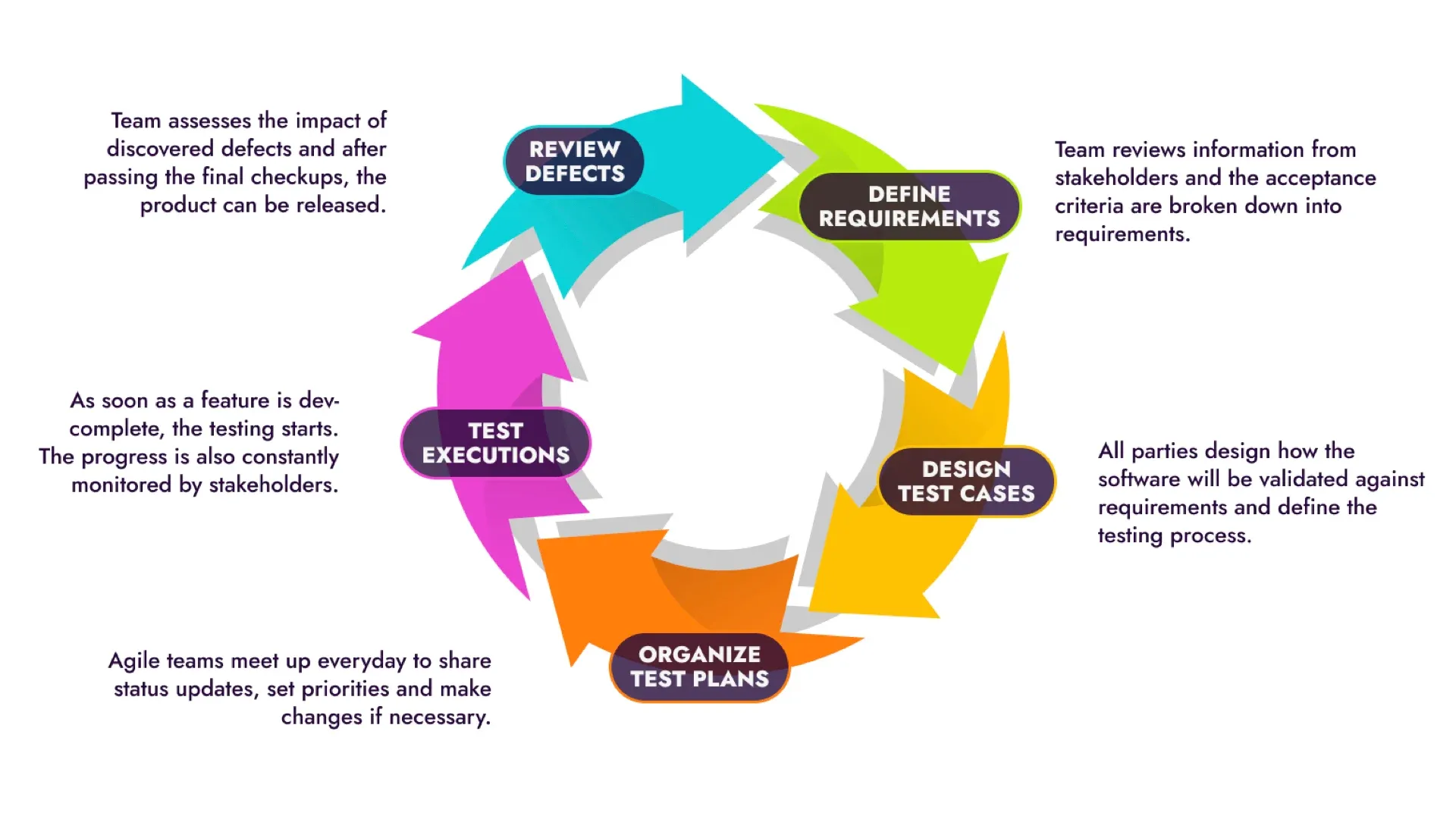
Put together, these five stages complete the Agile testing cycle and set the dynamic pace of the whole process.
The Agile Testing Quadrants
The agile testing quadrants, introduced by Brian Marick and popularized by Lisa Crispin and Janet Gregory in their book Agile Testing, help teams make sure they cover all types of testing, not only functional checks:
| Supporting the team | Critiquing the product | |
|---|---|---|
| Business-facing | Q2: Functional tests, story tests, examples | Q3: Exploratory testing, usability testing, user acceptance testing |
| Technology-facing | Q1: Unit tests, component tests | Q4: Performance, load, and security testing |
Tests on the left help the team build the product right; tests on the right check whether the result is right for users. Most teams automate Q1 and much of Q2, while Q3 relies on people and Q4 on specialized tools.
The Alignment of Agile Testing and ISTQB Principles
While the Agile approach may seem like a revolution, because of the collaboration mindset, continuous delivery and rapid feedback – at base, it remains grounded in the core principles of software testing.
Moreover, Agile testing principles that were just described align closely with the seven principles of testing, introduced by the International Software Testing Qualifications Board (ISTQB). To start, both sets of guidelines put emphasis on the reduced risks and costs that early testing brings. Similarly, both recognize that exhaustive testing is an impossible goal and testers are encouraged to prioritize tasks based on the current situation. On the final note, according to ISTQB principles, as well as the Agile ones, testing intends to show the presence of defects, not their lack. Agile methodologies bring this concept to life with frequent feedback loops and continuous iteration.
Fitting Appsvio Test Management into Agile QA Workflows
The speed and controlled chaos of Agile push QA teams towards implementation of a test management tool. It becomes a necessity, as a well-fitted tool can enhance tester’s daily workflow and make sure that the whole process is traceable. Atlassian Jira is an Agile project management tool and seems to be the most natural choice for the QA teams - they want to join others, where the whole software development process is documented.
Jira can be customized for testing, but building test cases, executions, and reports from scratch takes effort and is hard to maintain. This is where test management apps come in.
By putting such a tool to work, teams can meet the goals of Agile testing easier – they collaborate without silos, streamline the overall process and in the end, deliver the product faster. Ideally the QA team will find a tool that adjusts to their way of working and doesn’t limit their abilities. Selecting the right test management solution can be a decisive step toward improving collaboration, ensuring full traceability, and accelerating delivery within Agile environments. Appsvio Test Management (ATM) offers a seamless, fully integrated option - explore the app and see how it aligns with the team’s needs.
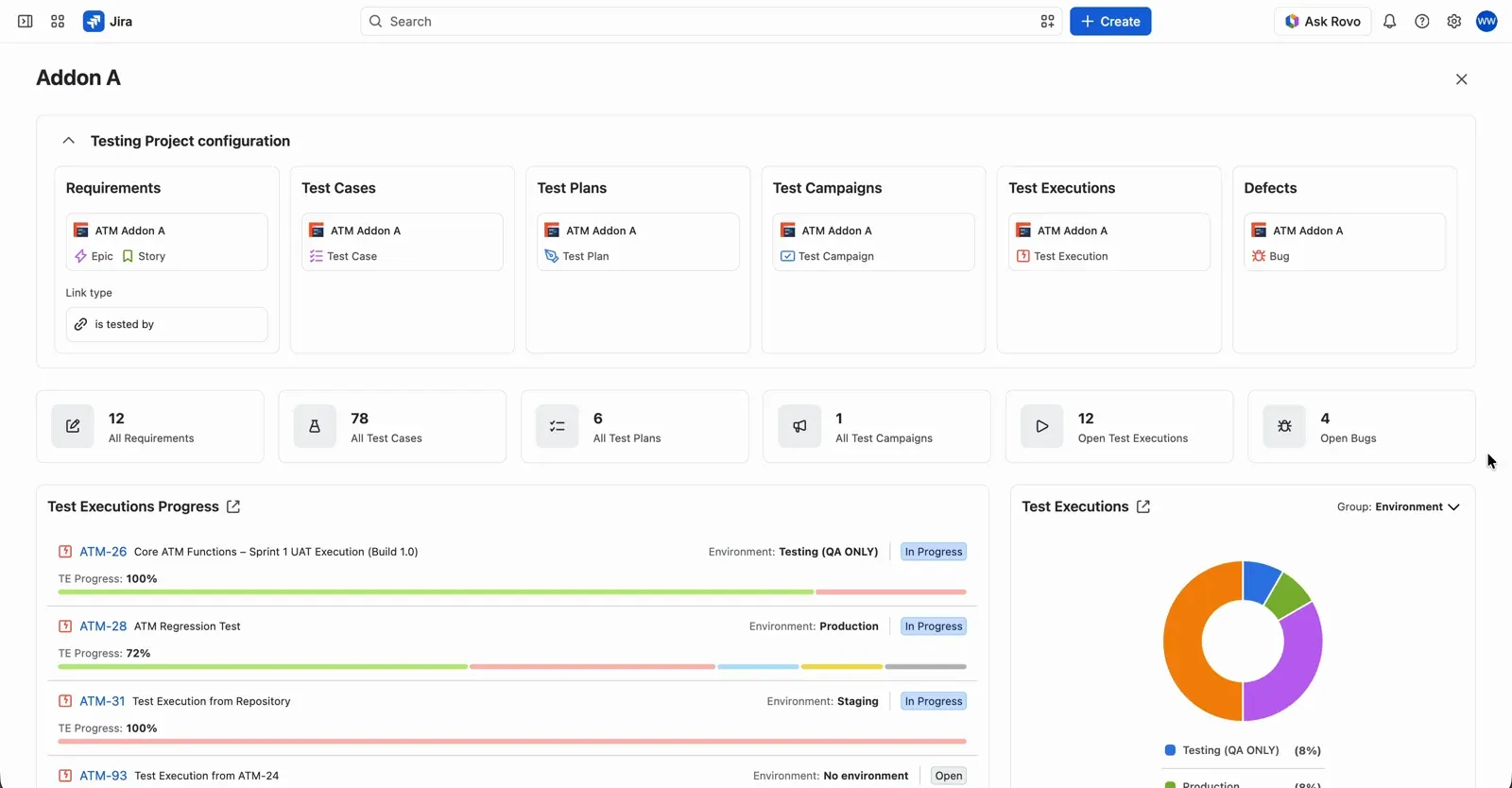
The Testing Project dashboard in Jira shows requirements, test cases, test plans, campaigns, open executions and defects, with execution progress below.
Here’s how ATM supports each stage of the agile testing lifecycle:
| Lifecycle stage | In Jira with ATM |
|---|---|
| Defining requirements | Requirements stay in your Jira spaces as any work type you map, such as Epics or Stories, and link to the test cases that verify them |
| Designing test cases | Test Cases are Jira work items with steps and preconditions; Test Case Architect, a Rovo agent, can propose test cases from a requirement |
| Daily adjustments and planning | Test Plans group the test cases for a sprint or release, and the Testing Project Dashboard shows execution progress and workload by assignee |
| Executing tests | Test Executions run from a Test Plan, typically one per environment, with results recorded for each test case |
| Reviewing defects | Defects are linked to the test case execution or step where they were found, collected on the Test Execution, and the Traceability report connects them back to requirements |
Watch how to plan and track testing in Jira with Test Plans and Test Campaigns (7 min):
Want to see even more? Watch the recording of our webinar on how to organize tests in Jira with ATM and choose a test setup that fits your team.
The Key Takeaways
The Agile approach redefines the place of software testing in the development cycle, making it an ongoing process, not a singular step. The focus is shifted on team-collaboration, adaptability, early feedback and testers gain a chance to deliver high-quality software in a shorter amount of time.
By understanding principles and lifecycle of Agile testing, teams’ efforts can be better aligned with the project goals – all resulting in a final product that truly meets users’ expectations. As Agile continues to shape modern development, mastering its testing practices may be no longer optional, but essential.
Run agile testing in Jira
Plan, run, and track tests sprint by sprint, right where your team already works, with Appsvio Test Management.
Try it freeThis article was updated on October 16, 2026.
Related posts

Dariusz Jaroń
•Oct 2, 2026


Dariusz Jaroń
•Sep 23, 2026